
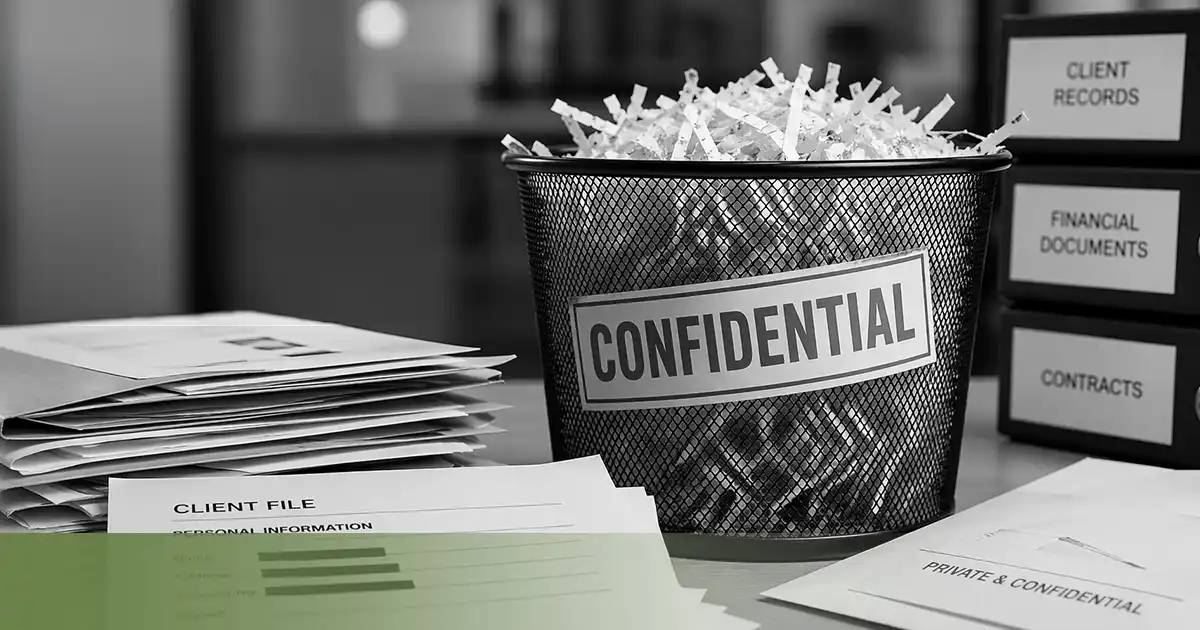
How Poor Document Disposal Practices Can Damage Trust with Clients
Think about the last time you handed over a bank statement, a signed contract, or a form containing your home address. You trusted the organisation on the receiving end to look after it. Most people don’t think beyond that moment. But what happens to that document when it’s no longer needed? Where does it go, and who handles it on the way out?
For the organisations holding that information, the answer matters a great deal. Not just legally, but in terms of the relationships they’ve spent years building.
The Part of Data Protection Nobody Talks About
Most businesses have some kind of policy around storing confidential data. Fewer have thought carefully about document disposal. It tends to get treated as a routine administrative task rather than a genuine data protection issue, and that’s where problems begin.
Physical documents carry the same risks as digital data. A letter containing a client’s financial details, a form with a patient’s address, a contract outlining commercially sensitive terms — none of these become less sensitive just because they’re no longer in active use. Leaving them in a standard waste bin, a pile on a desk, or a bag waiting for general collection is effectively leaving that information unprotected.
The risks aren’t theoretical. Strip-cut shredding, which many offices still use, produces long ribbons of paper that have been successfully reconstructed by determined individuals. Documents left in general waste skip the shredding step altogether.
What the Law Says
Under the UK General Data Protection Regulation and the Data Protection Act 2018, organisations are required to handle personal data securely throughout its entire lifecycle. That includes disposal. The Information Commissioner’s Office has the power to fine organisations up to £17.5 million for serious breaches, or four per cent of global annual turnover if that figure is higher.
Compliance is the legal minimum, not the ambition. The more pressing concern for most organisations isn’t the fine — it’s what a publicised failure does to client confidence.
What Happens When It Goes Wrong
In 2013, Scottish Borders Council was fined £250,000 by the ICO after employee pension records were found dumped in a supermarket car park. No sophisticated systems failure was involved. No cyber attack. The records were simply disposed of without any secure destruction process in place.
That case predates UK GDPR, under which the penalties would now be considerably higher. But the point that stays relevant is simpler than the fine: once documents like that are found in the wrong place, the reputational damage is immediate and lasting. Penalty amounts fade from the headlines. The story of what went wrong does not.
The Effect on Client Relationships
Clients in sectors like financial services, law, healthcare, and accountancy are placing a particular kind of trust in their service providers. Confidentiality isn’t a nice feature — it’s a basic expectation of the relationship. When that expectation is visibly not being met, the consequences can be serious.
Clients who learn that their information hasn’t been handled carefully may simply start withholding it. They may become reluctant to share documents, slow to respond to requests, or quietly begin looking elsewhere. Some will just leave. They rarely say exactly why, which makes the problem harder to identify and even harder to recover from.
There’s also the question of word of mouth. A client who has reason to question how your organisation handles confidential materials is unlikely to recommend you without reservation. In professional services, where referrals carry real weight, that kind of quiet erosion matters.
Getting Disposal Right
Organisations that take confidential waste seriously tend to approach it the same way they approach the rest of their data protection obligations: with clear processes, staff training, and a reliable external partner to provide what can’t be done adequately in house.
In practice, that means secure, lockable collection bins rather than open waste sacks, cross-cut destruction rather than strip-cut, and a clear audit trail showing what was destroyed and when. A certificate of destruction serves exactly this purpose — it’s documented evidence that specific materials were disposed of properly, which is useful both for internal compliance records and for demonstrating due diligence if questions are ever raised.
Regular reviews also help. Disposal processes drift over time, particularly in growing organisations where the volume and type of documents in circulation changes. A process that worked two years ago may have gaps today.
Working with Shredsec
Shredsec provides secure shredding services for businesses and organisations across London, East Anglia, and the East Midlands. Every collection is followed by a certificate of destruction, giving you a clear, documented record for compliance and client assurance purposes.
Whether you need a regular scheduled service or a one-off clearance, we can help you put a practical, compliant disposal process in place. Take a look at our secure shredding services or get in touch to talk through what you need.
Disposing of documents securely isn’t an optional extra. It’s as much a part of looking after your clients as anything else you do.
Contact Shredsec to discuss your shredding requirements.