
How Businesses Can Demonstrate Responsible Data Disposal Practices
Most businesses have got reasonably good at protecting data while it is being used. Access controls, password policies, encrypted storage — these have become standard practice for organisations of almost any size. What tends to get less attention is what happens to information at the end of its life. That gap is where a surprising number of data protection failures occur.
Throwing confidential paperwork in the recycling, donating an old laptop without wiping the hard drive, clearing out a filing cabinet during an office move — these are the kinds of decisions that can expose customer records, employee information or commercially sensitive documents to people who should never see them. Under the UK GDPR and the Data Protection Act 2018, secure disposal is not optional. The ICO’s accountability principle requires organisations to handle personal data responsibly throughout its entire lifecycle, right up to the point of destruction — and to be able to show that they have done so. For more on how this applies specifically to document destruction, our article on GDPR and document destruction compliance covers the detail.
Knowing What You Actually Hold
Before you can dispose of information responsibly, you need a reasonable picture of what you have. Most businesses accumulate documents over years without ever taking stock — contracts from suppliers that no longer exist, personnel files for people who left a decade ago, financial records well past any legal retention requirement.
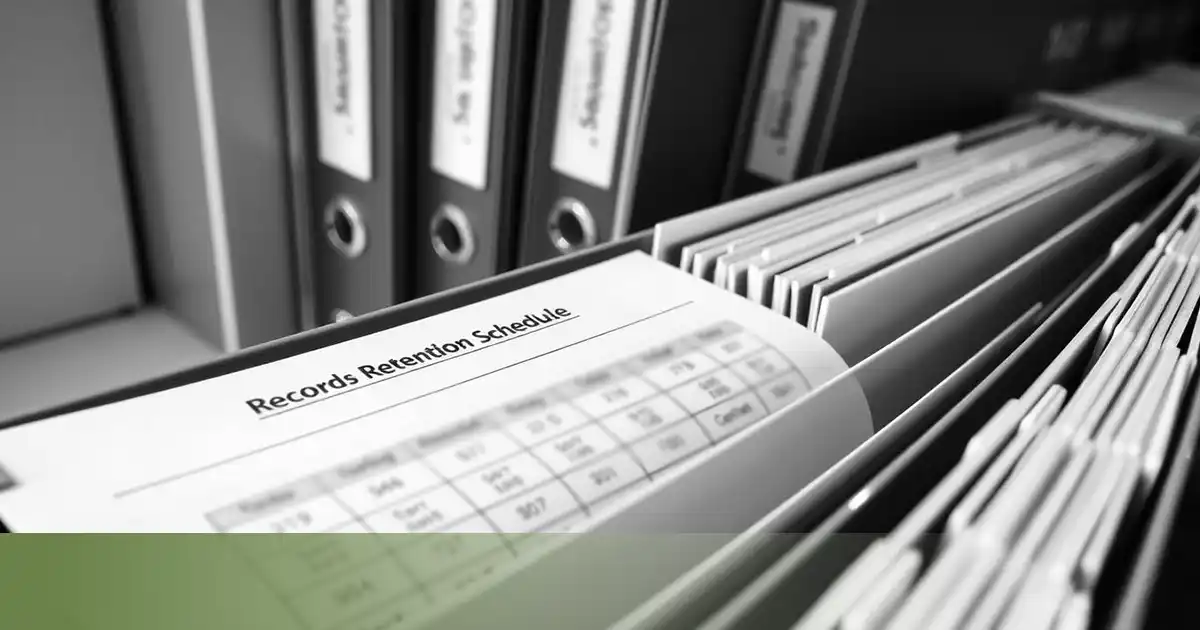
The starting point is a retention policy: a straightforward document that sets out what categories of records the business holds, how long each should be kept, and what should happen to them at the end of that period. HMRC guidance sets a minimum of six years for most financial records. Employment records are typically kept for seven years after someone leaves. Getting these timescales written down and communicated to staff reduces the chances of either destroying something too early or hanging on to personal data far longer than you need to.
If this is something your business has not yet looked at formally, our data disposal resource covers the main categories, and our article on conducting a document retention review is a useful place to start.
How Documents Should Actually Be Destroyed
Putting confidential paperwork in a recycling bin is not secure disposal. Neither is dropping a bag of old files into a general waste skip during an office clearout. Documents discarded this way remain readable, and the ICO has taken action against organisations for exactly this kind of oversight.
Confidential shredding is the practical solution for paper records. Professional shredding services work to security levels set out in the DIN 66399 standard, which runs from P-1 (basic strip cutting) through to P-7 (fine cross-cut destruction used for top-secret material). The level you need depends on the sensitivity of what is being destroyed — personnel records and customer financial data warrant a higher level than general business correspondence.
For businesses with a regular volume of confidential waste, a scheduled shredding service means destruction happens consistently and is documented without requiring any management time. If you would rather see the process take place, on-site mobile shredding brings the shredding vehicle to your premises and destroys material before it leaves your site.
Electronic media is a separate consideration that businesses often underestimate. Deleting files from a hard drive does not remove the data — it simply removes the pointer to it. The NCSC guidance on secure sanitisation of storage media sets out the appropriate approaches depending on how sensitive the data is and whether the device is being reused, donated or disposed of entirely. For devices containing sensitive personal or commercial data, physical destruction is often the only approach that provides genuine assurance.
Policies, Training and Keeping Procedures Current
Secure destruction methods only work if people use them. That means having clear written procedures, making sure staff know what is expected of them, and following up to check that the procedures are actually being followed.
A disposal policy does not need to be lengthy. It needs to cover how different types of information are classified, where confidential waste should go rather than in general bins, and who is responsible for overseeing the process. Contractors and temporary staff should be included, not just permanent employees — information security failures do not distinguish between employment types.
Procedures should also be revisited periodically. A process that worked well for a business with twenty staff and one office may not be adequate for the same business three years later with four locations and a hybrid working policy. Changes in regulation, technology or the types of data you hold are all good reasons to review what you have in place.
Keeping Records of Destruction
Being able to demonstrate responsible disposal matters as much as the disposal itself. If a client asks for evidence that their data has been securely destroyed, or if the ICO investigates a complaint, a verbal assurance is not going to be sufficient.
An audit trail should record what was destroyed, when, how and who authorised it. Where you use an external shredding provider, you should receive a certificate of destruction for each collection or job. A certificate typically includes the date of destruction, the quantity of material, the destruction method used and the details of the company that carried out the work. For businesses using an off-site shredding service, issuing certificates of destruction should be standard practice from any reputable provider — if it is not offered, that is worth querying.
Keeping these records alongside your other information governance documentation means you have the evidence to hand if you ever need it, whether for a client audit, a procurement requirement or a regulatory enquiry.
What This Means for Trust
There is a reputational dimension here that goes beyond regulatory compliance. Clients — particularly larger organisations with their own procurement and due-diligence processes — increasingly want to see evidence that their suppliers handle information responsibly. Being able to point to documented disposal procedures and certificates of destruction is a practical demonstration that your business takes data protection seriously, rather than just stating that it does.
For smaller businesses, this might feel like an overhead that belongs to larger organisations. In practice, the basics are straightforward to put in place, and the risk of getting it wrong — a complaint, an ICO investigation, a story about discarded documents — is not one that scales with company size.
Making It a Habit Rather Than a One-Off
The businesses that handle data disposal well tend to treat it as a routine part of how they operate, rather than something that gets attention only when there is a problem or an office move on the horizon.
If your business has a backlog of documents that have never been through a proper disposal process, a one-off shredding service is a straightforward way to clear it. From there, building a regular process — whether through a scheduled collection or an internal procedure with an external provider on call — means disposal stops being something that accumulates and becomes a periodic concern.
The practical steps are not complicated: know what you hold, destroy it securely when the time comes, keep a record that you did so, and make sure your staff know what to do. Done consistently, that is what responsible data disposal looks like in practice.
Contact Shredsec to discuss your shredding requirements.